


How to Ride Seoul Buses: Colors, Route Numbers & Easy Transfers
서울 버스 타는 법: 색상, 노선번호와 간편한 환승
Seoul Is Bigger Than Its Subway Map
Estimated reading time: About 6 minutes
The subway is excellent for crossing Seoul, but buses often get closer to hillside neighborhoods, markets, parks, cafes, and filming locations between stations. A direct bus can also be simpler than making two subway transfers for a short trip.
The system looks complicated only until you learn three things: the color, the number, and the exact stop.
The short version: Find the route in a live map, match the bus number and destination, enter through the front door, tap your transit card, press the stop button, tap again, and exit through the rear door.
Your First Seoul Bus Ride in 6 Steps
The Seoul Metropolitan Government's English guide confirms the basic sequence below (Seoul Metropolitan Government).
- Plan with live information. In a Korean map app or Seoul TOPIS, check the route, direction, arrival time, and boarding point.
- Match the exact stop. Busy areas may have several stops with similar names, so compare the five-digit stop ID when shown.
- Board through the front door. Let passengers off, then tap your transit card on the reader beside the driver.
- Watch the next-stop display. Hold a rail or take a seat before the bus moves.
- Press a red stop button before your stop. Do not wait until the bus has already passed it.
- Tap out and leave through the rear door. The second tap closes your journey record and protects your transfer discount.
First-ride tip: Keep the live route open and count down the stops. Save a screenshot of the destination name in Korean as a backup.
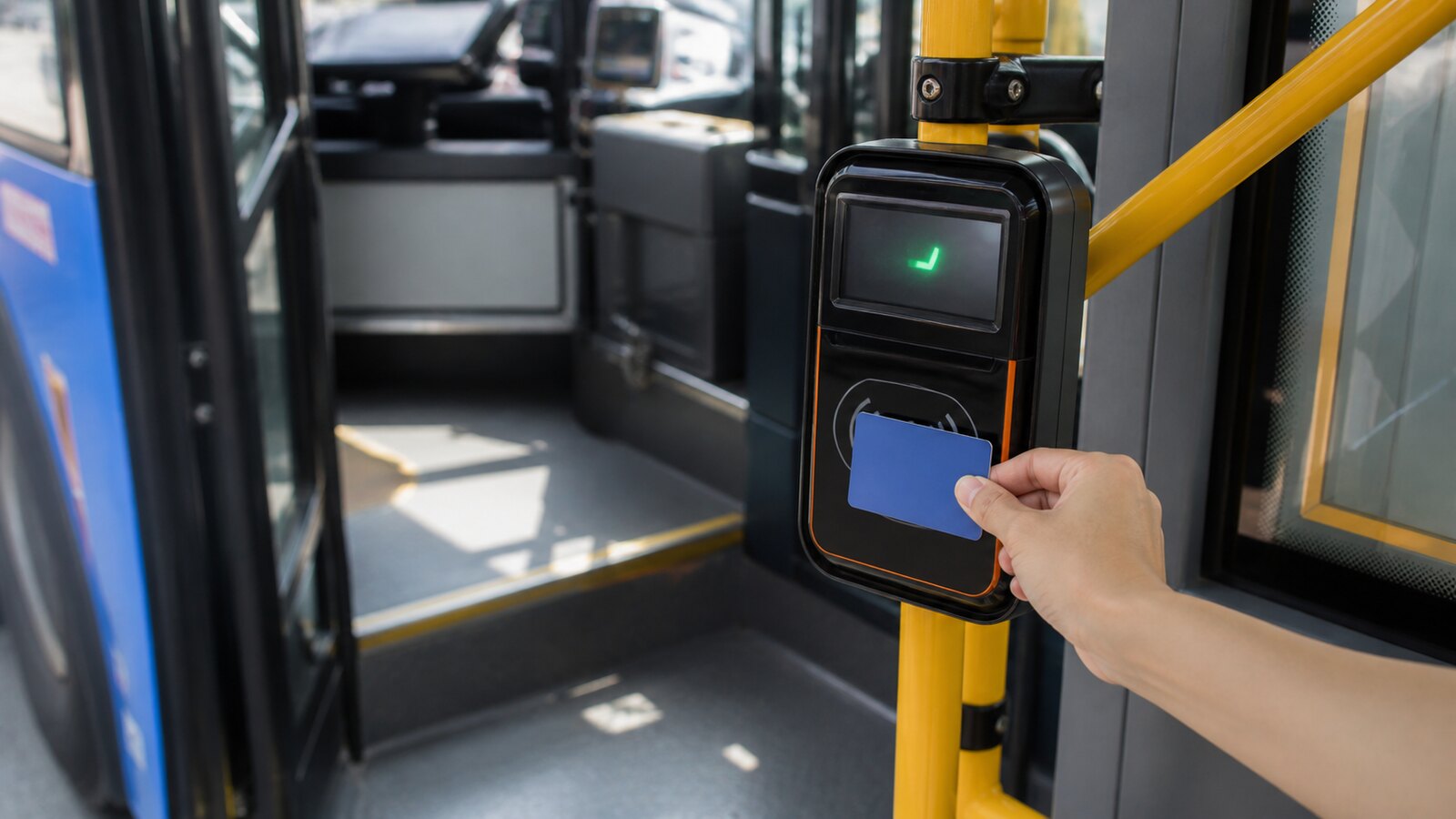
Tap once on the reader by the front door when boarding, then tap again by the rear door before exiting. This original 2026 reference image shows no card number, balance, face, or other personal data. AI-generated by OpenAI image_gen after checking current Seoul bus-reader references.
Blue, Green, and Village Buses—and the Circulation-Bus Exception
Seoul officially groups its routes by what they do, not simply by vehicle size (Seoul Metropolitan Government).
| What you see | Official type | What it is best for |
|---|---|---|
| Blue full-size bus | Trunk bus (간선버스) | Longer trips linking outer Seoul, major centers, and sub-centers |
| Green full-size bus | Branch bus (지선버스) | Neighborhood travel and connections to blue buses or subway stations |
| Green smaller bus, usually with a district name | Village bus (마을버스) | Short local routes on narrow or hilly streets and feeder trips to nearby stations |
| Do not rely on one color; Namsan's 01A/01B buses are commonly pink or mint Haechi-wrapped vehicles | Circulation bus (순환버스) | Short loops around central attractions, including Namsan |
| Red bus | Rapid bus (광역버스) | Longer cross-boundary trips between Seoul and the surrounding metropolitan area |
| N + number | Owl/night bus (심야버스) | Selected corridors after regular subway and bus service winds down |
Inside Seoul, think blue for wider movement, green for neighborhood connections, and village buses for the last short section. Color is only a clue: Gyeonggi and Incheon buses use different systems.
2026 circulation-bus exception: Yellow is the legacy color in older explanations. Seoul later used a green-and-yellow electric circulation-bus design (Seoul Metropolitan Government); Namsan routes 01A and 01B received pink or mint Haechi wraps in 2024 (Seoul Metropolitan Government), still documented in November 2025 (Seoul Metropolitan Government). As checked in August 2026, trust the 01A/01B route display and destination, not body color alone.
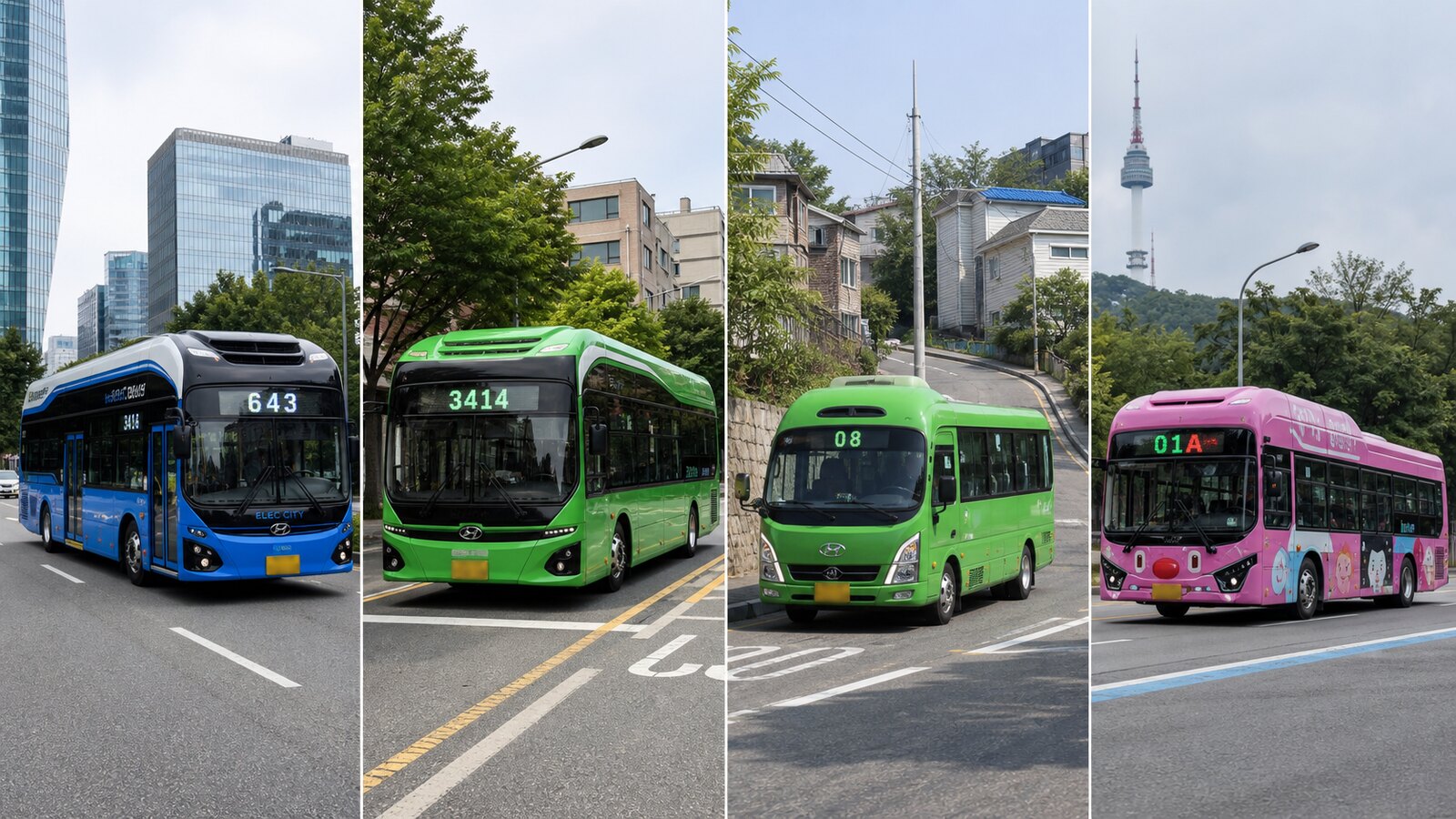
Left to right: blue trunk, green branch, green village, and pink Haechi-wrapped circulation bus. These are representative 2026 appearances, so always confirm the live route display. AI-generated by OpenAI image_gen after checking current vehicle references; no source photograph or identifiable person was reproduced.
What Seoul Bus Numbers Actually Tell You
Bus numbers are geographic clues. Seoul uses eight zones, 0 to 7, and many route numbers reflect departure and arrival zones (Seoul TOPIS).
| Zone | Main Seoul districts |
|---|---|
| 0 | Jongno, Jung, Yongsan |
| 1 | Seongbuk, Gangbuk, Dobong, Nowon |
| 2 | Seongdong, Gwangjin, Dongdaemun, Jungnang |
| 3 | Songpa, Gangdong |
| 4 | Seocho, Gangnam |
| 5 | Geumcheon, Dongjak, Gwanak |
| 6 | Yangcheon, Gangseo, Guro, Yeongdeungpo |
| 7 | Eunpyeong, Seodaemun, Mapo |
Blue Bus Example: 643
For a three-digit blue route, the usual pattern is:
departure zone + arrival zone + route sequence
So 643 can be read as:
- 6: starts in the southwest zone, which includes Yangcheon
- 4: travels toward the Seocho–Gangnam zone
- 3: identifies the individual route within that zone pair
Route 643 links Yangcheon Public Garage and the Gangnam Station area. The code suggests direction; it does not replace a live route check.
Green, Village, and Night Numbers
- A four-digit green branch bus usually uses two zone digits plus a two-digit sequence. 5511, for example, stays within zone 5 and is sequence 11.
- A village bus usually combines a district with a local number, such as
Jongno 09; it is not the citywide blue/green code. - An N bus uses
Nfor night service followed by the zones it connects. Always confirm the current path because routes can be revised.
Do not over-decode the number. Direction screens, stop IDs, and live arrival information are more reliable than guessing from the digits alone.
Median Stop or Curbside Stop?
This often confuses first-time riders around Gangnam Station, Jongno, and other wide boulevards.
| Median bus stop (중앙차로 정류장) | Curbside bus stop (가로변 정류장) | |
|---|---|---|
| Where it is | On a protected platform in the middle of the road | Beside the sidewalk at the road edge |
| How to reach it | Use the marked crosswalk and pedestrian signal | Walk to the roadside shelter or pole |
| Boarding method | Front door and tap in | Front door and tap in |
| Main risk | Waiting on the wrong directional platform | Choosing one of several nearby curbside stops with similar names |
The fare and boarding process are the same; only the waiting location changes. Seoul counted 379 median stops and 6,307 curbside stops as of January 2026 (Seoul Metropolitan Government, updated March 9, 2026).
At a median stop:
- Enter only by the marked crossing on a green pedestrian signal—never through traffic.
- Check the direction before crossing and match the platform route number with the approaching bus.
- Follow your route planner's exact pin; a bus may skip a nearby curbside stop with the same station name.
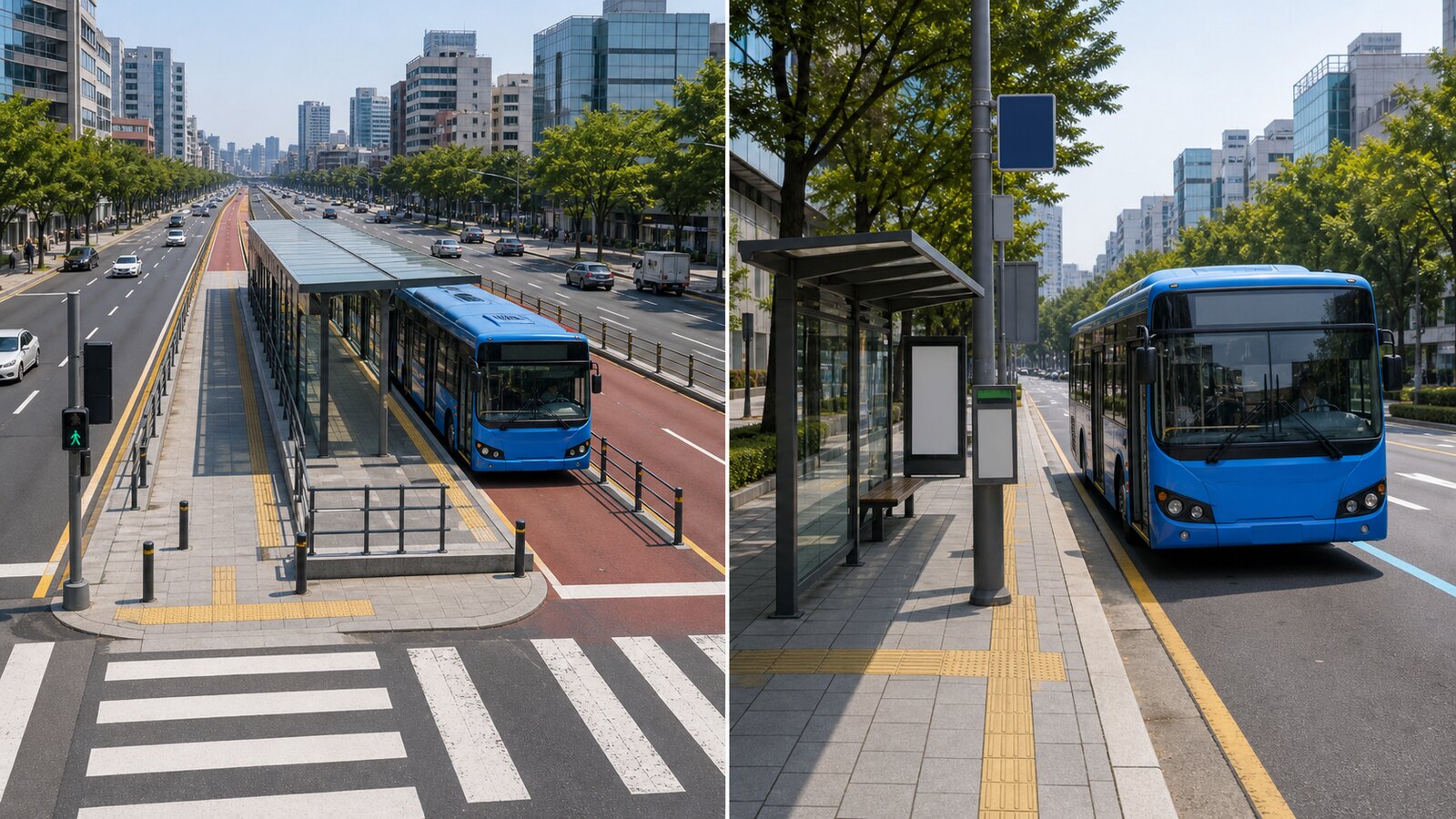
Left: reach a median platform only by the marked crosswalk and signal. Right: a curbside stop sits directly beside the sidewalk. The bus still boards through its right-side front door in both cases. AI-generated by OpenAI image_gen after checking 2025–2026 Seoul stop references; locations, signs, and people are not reproduced.
The Tap-Tap Rule Makes Transfers Simple
Use a compatible transit card such as Tmoney, sold and reloaded at subway stations and participating convenience stores. VisitKorea explains the front- and rear-reader process in English (VisitKorea). Some Seoul buses do not collect cash (Seoul Metropolitan Government, January 2026 list), so a card is the dependable choice.
The current city-published adult fares are KRW 1,500 for blue and green city buses, KRW 1,200 for village buses, and KRW 2,500 for owl buses. Those fares took effect on August 12, 2023, and the city's fare page was updated on March 9, 2026 (Seoul Metropolitan Government).
For a discounted transfer:
- Tap when you board.
- Tap when you leave.
- Board the next bus or subway within 30 minutes.
- From 9 p.m. to 7 a.m., the window is 60 minutes.
- Up to four transfers are recognized, for a maximum of five boardings.
- The same vehicle or the same bus route does not qualify as a transfer.
Transfers are distance-based, not simply “free”: extra distance can add a charge. That is why tapping out matters even if you think the trip is finished.
When the Subway Stops: Look for N
Seoul's owl buses use an N prefix on selected late-night corridors. When a route matches your destination, they can be a low-cost alternative to a taxi after the subway stops.
There are two important limits:
- N buses do not reproduce the full daytime network.
- Service can be infrequent, so check the live arrival time and the final walking section before you commit.
Adult fare is KRW 2,500, and the late-night transfer window is 60 minutes. Check the exact N route on TOPIS shortly before departure.
What About Gyeonggi, Incheon, and M Buses?
- Gyeonggi and Incheon buses are operated under their own regional systems. Their colors and numbers do not follow Seoul's 0–7 decoder.
- M buses are metropolitan express routes. They cross city or provincial boundaries with fewer stops than ordinary local services; some metropolitan routes also offer seat reservations through designated apps (Metropolitan Transport Commission).
- Seoul, Gyeonggi, Incheon buses, and the metropolitan subway participate in the integrated metropolitan fare system, but the starting fare and distance calculation can differ by service (Seoul TOPIS).
Treat the operator, stop, fare, and seating rules as route-specific. Gyeonggi, Incheon, and M buses will be covered separately.
A Simple Checklist Before You Board
Save this before your next ride:
- Correct route number
- Correct direction or final destination
- Exact stop pin and five-digit stop ID
- Median platform or curbside stop
- Transit card with enough balance
- Two taps: on and off
- Stop button pressed before arrival
Once these checks become automatic, Seoul buses are an easy way to see the city at street level. Before your next X30 campaign, save the destination and choose the route that drops you closest.
References
- Seoul Metropolitan Government — Bus System, Fares, Transfers, Colors and Numbering
- Seoul Metropolitan Government — How to Use Seoul Public Transportation
- Seoul TOPIS — Bus Types, Numbering Zones and Integrated Fare System
- Seoul TOPIS — Live Bus and Traffic Information
- VisitKorea — Transportation Card Use
- Seoul Metropolitan Government — Cashless Bus Routes, January 2026
- Seoul Metropolitan Government — Green-and-Yellow Electric Circulation Bus Design
- Seoul Metropolitan Government — Pink and Mint Haechi Buses on Routes 01A and 01B
- Seoul Metropolitan Government — Haechi-Wrapped 01A and 01B Buses, November 2025
- Metropolitan Transport Commission — Metropolitan Bus Seat Reservations


