


Seoul Goshiwon Guide: What It Means, Who It Suits, and How to Find a Good Room
서울 고시원 가이드: 의미와 역사, Z세대 트렌드와 좋은 방 구하는 법
A Small Room, a Flexible Seoul Base
Estimated reading time: About 8 minutes
Seoul has a talent for fitting a desk, a bed, and a surprisingly large life into a surprisingly small room. If you need a furnished base with a lower upfront cost and a flexible move-in plan, a gosiwon may be worth considering.
Longer stays can be difficult when privacy, storage, cooking space, or quiet are priorities. But if you are arriving in Seoul before you have secured a longer-term home, a furnished goshiwon can work as a short-term bridge: stay for a few weeks or months, learn the neighborhood, and search for your next place from the city rather than from an airport suitcase. If you contact a property from abroad, confirm the exact room, dates, total cost, and cancellation terms in writing. Flexible move-in and move-out terms are among the reasons international students have reported considering goshiwon (Korea JoongAng Daily).
It is also a type of housing where the details do the heavy lifting. Two rooms with the same label can feel worlds apart depending on the window, ventilation, bathroom, soundproofing, and management.
This guide explains what a goshiwon means, how it changed from an exam-preparation room into a form of micro-housing, why some younger Koreans and international residents consider it, and what to inspect before you pay.
The short version: Treat a goshiwon as a practical landing pad, not a guaranteed lifestyle upgrade. Compare the actual room and safety conditions—not just the name or listing photos.
What Is a Goshiwon?
The Korean Basic Dictionary defines gosiwon as a room rented monthly for studying and sleeping, traditionally for people preparing for exams (Korean Basic Dictionary).
In practice, a goshiwon is a private room inside a building where residents share some facilities. A typical room may include:
- A single bed and desk
- A compact wardrobe or storage shelf
- Wi-Fi and an air conditioner or other heating and cooling system
- A mini refrigerator in some rooms
- A shared kitchen, laundry area, toilet, and shower—or private facilities in upgraded rooms
The Korean names you will see in listings include 고시원 (gosiwon), 고시텔 (goshitel), 원룸텔 (one-room-tel), and 리빙텔 (living-tel). These are useful search terms, but they are not reliable quality grades. One current listing, for example, describes itself as a gosiwon and goshitel, categorizes rooms as one-room-tel, and uses “living-tel” as part of its business description (Gobang listing).
The cover image’s generic 고시텔 sign makes the point neatly: signage tells you what to search for, not what you will get. The practical questions are simpler: Does the room have an exterior window? Is the bathroom private? What is shared? What does the monthly payment include?
From Exam Rooms to Seoul Micro-Housing
Goshiwon began as a study-and-sleep solution for exam candidates clustered around universities and academies. The Academy of Korean Studies traces the rise of gosichon—an area where exam candidates live densely—to the early 1980s. Daehak-dong, formerly Sillim 9-dong, grew as an exam district after Seoul National University moved there in 1975; Noryangjin later became another major concentration (Academy of Korean Studies).
The residents and the rooms changed over time. After the late-1990s financial crisis, goshiwon also became housing for workers with unstable incomes and people who could not manage a conventional deposit (Yonhap News). As exam systems changed and exam-focused populations declined, young workers, students, and other one-person households increasingly used the same kind of room as a place to live.
The physical difference is easy to understand. Older reports show closely spaced doors, narrow corridors, shared bathrooms, and rooms where a bed and desk take up nearly all the floor area. Later remodels introduced wider circulation, private bathrooms, individual heating and cooling, brighter finishes, and more deliberate common spaces (ChosunBiz).
That does not mean every goshiwon has been upgraded. Recent reporting from around Seoul National University still documents rooms of roughly two to three pyeong, interior-facing windows, limited storage, noise, moisture, and shared facilities that can be difficult at busy times (Seoul National University Newspaper). The history of goshiwon is therefore both a story of adaptation and a reminder that a new sign or brighter wallpaper does not guarantee a better room.
What Seoul Goshiwon Looks Like Now
Think of Seoul goshiwon as a spectrum rather than one fixed product. A narrow room may have a shared bathroom down the hall; a remodeled goshitel may fit a private shower booth beside the bed. The floor plan—not the label—usually tells the more honest story.
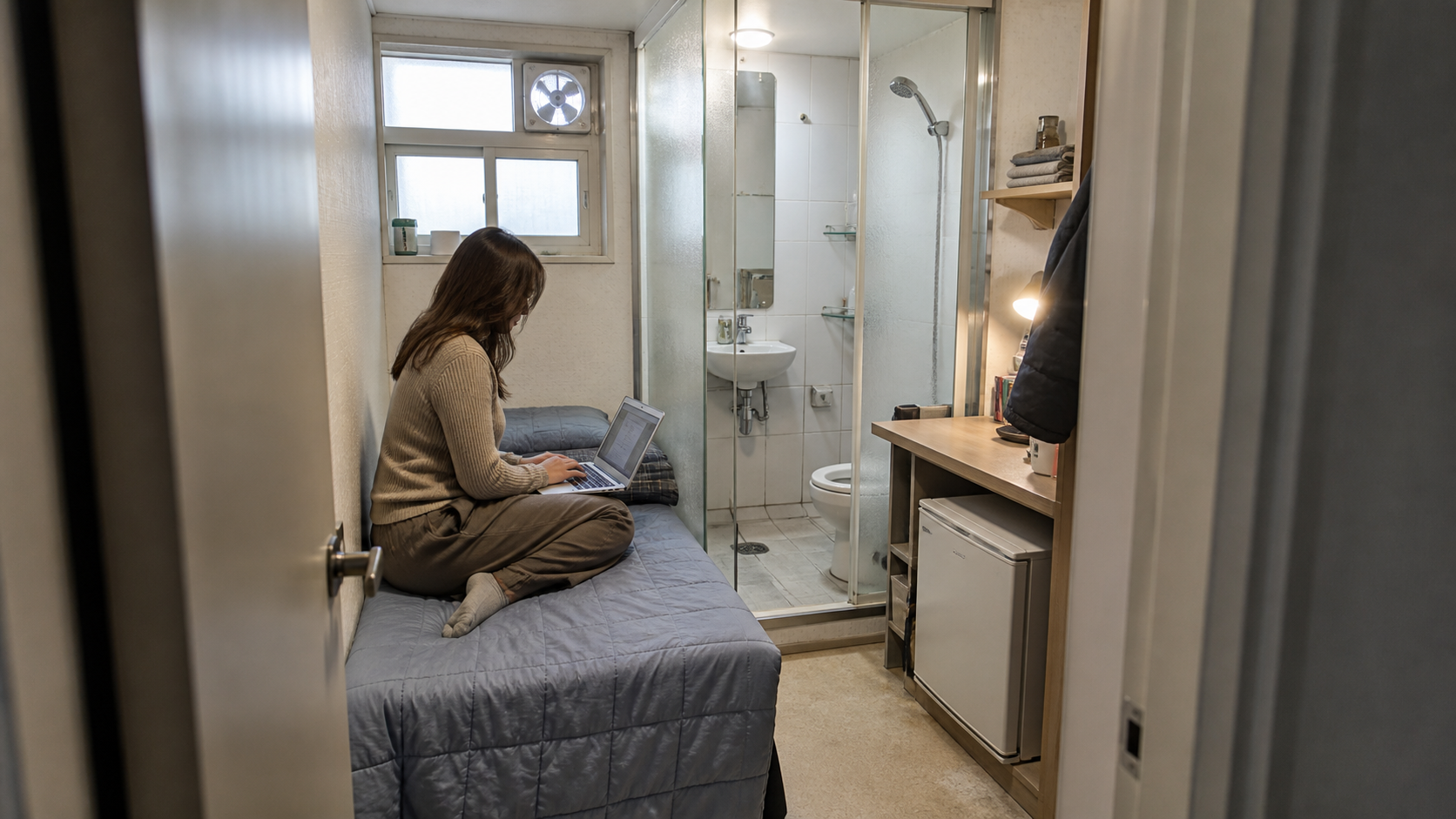
AI-generated by OpenAI image_gen for X30. This fictional composite was selected from the supplied image set; it does not depict a real resident or facility. The compact bed-and-shower relationship was informed by public reporting from Hankook Ilbo, The Korea Times, and a current Anam listing.
| Type you may see | Common features | What to verify |
|---|---|---|
| Classic gosiwon | Bed and desk, shared bathroom and kitchen, compact room | Exterior window, ventilation, noise, number of shared facilities |
| Goshitel / one-room-tel | More furnished room, private shower or toilet in some cases | Whether the bathroom is truly private, water pressure, storage |
| Remodeled or premium goshiwon | Brighter interiors, private bathroom, laundry equipment, controlled entry | Whether the higher rent reflects usable space and safe construction—not only decoration |
Prices vary by neighborhood, room size, window, bathroom, and contract length. A 2025 field report found many one- to two-pyeong rooms in the KRW 300,000–500,000 range, while a single Seocho listing checked in August 2026 advertised KRW 430,000–620,000 per month with a KRW 100,000 deposit (News Tomato, Gobang). These are dated examples, not a Seoul-wide average. Ask for the current total, including any management fee and utilities, before you compare.
Why Some Younger Koreans Are Considering It Again
It is tempting to call goshiwon a new Gen Z trend, but the available data needs more careful wording. Official statistics usually describe youth aged 19–39 or all one-person households, not Gen Z goshiwon preferences specifically.
In 2024, one-person households reached 8.045 million, or 36.1% of all households in Korea; 42.7% of one-person households lived in Seoul and Gyeonggi (Ministry of Data and Statistics). Seoul’s youth statistics also show a continuing net inflow of younger residents, with the city defining youth as ages 19–39 (Seoul Metropolitan Government).
Against that background, some younger renters consider goshiwon for four practical reasons—not because one statistic has crowned it the next big thing:
- Lower upfront cash: A goshiwon may require a small deposit or none, unlike many conventional Seoul rentals.
- Furnished arrival: Bed, desk, Wi-Fi, laundry, and basic kitchen supplies can reduce the cost and effort of starting from zero.
- Central access: Rooms near universities, stations, and employment districts can shorten a daily commute.
- A temporary base: A resident can use it while looking for a longer-term room, starting a job, attending school, or saving for a different housing option.
The other side matters just as much. A 2025 MBC report connected the tiny rooms it documented with youth housing pressure, regional job concentration, and a shortage of affordable alternatives (MBC News). For some residents, a goshiwon is an intentional short-term trade-off; for others, it is the only immediately available option. A useful guide should respect both realities.
Why It Is on the Radar of International Gen Z
For an international student, working-holiday participant, or young professional arriving in Seoul, a goshiwon can reduce the number of decisions required on day one:
- You may not need to buy furniture immediately.
- The deposit can be smaller than the deposit for a studio apartment.
- The room may be close to a university, language school, subway station, convenience store, or part-time job.
- A short or flexible stay can work as a bridge while you learn Seoul’s neighborhoods and rental vocabulary.
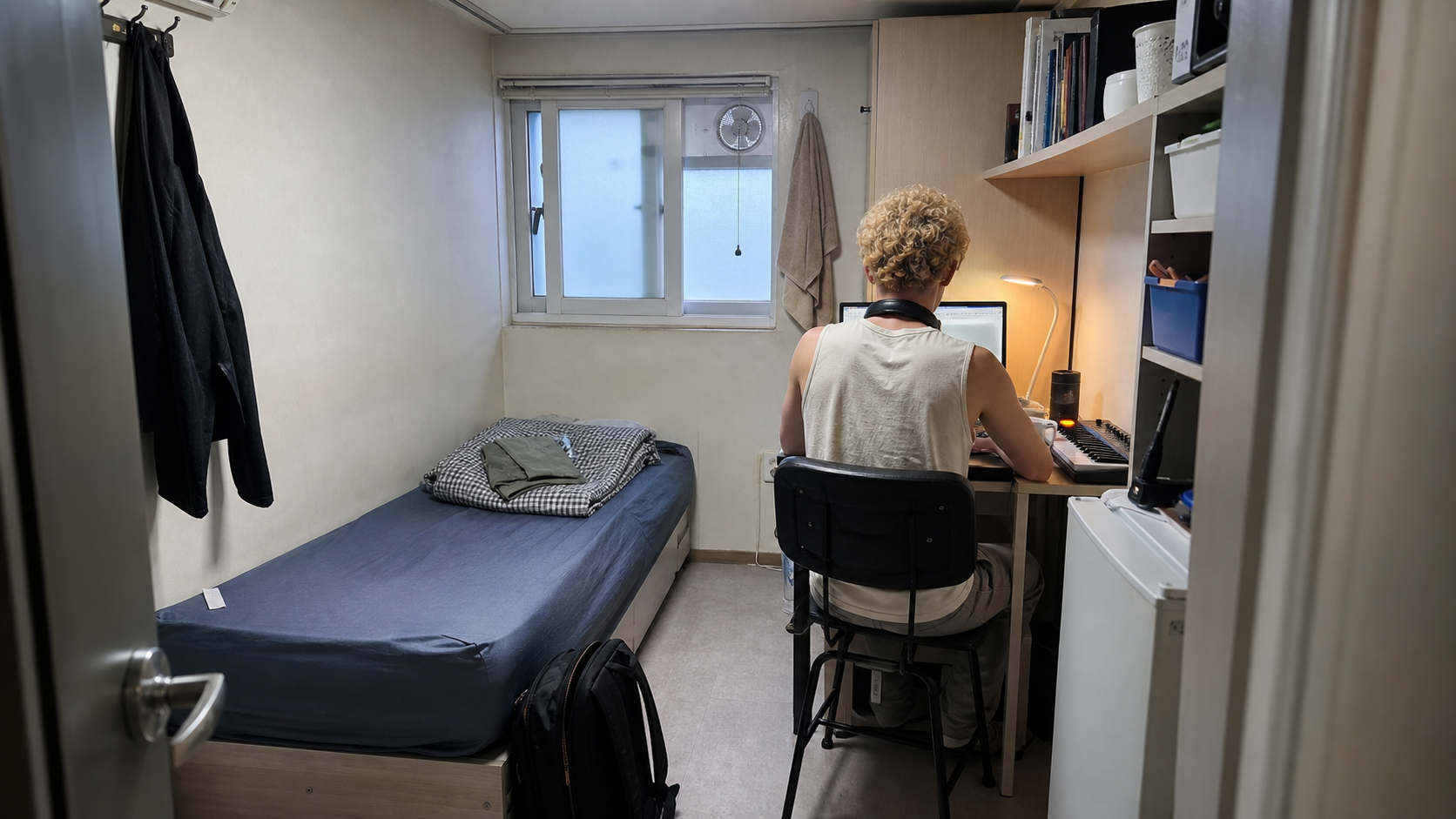
AI-generated by OpenAI image_gen for X30. The person and scene are fictional and the resident is shown from behind. The restrained music cues were informed by a Sinchon listing that describes a tablet and Bluetooth speaker in each room; the listing does not depict this person or event.
Interviews with international students in Seoul describe flexible move-in and move-out terms, location, furnished rooms, shared supplies, and the desire to avoid a large deposit as reasons for considering goshiwon (Korea JoongAng Daily). This is useful evidence of motivation, but it is not a survey proving that international Gen Z broadly prefers goshiwon.
The best approach is to treat the room as a landing pad. Korea’s official Study in Korea guide recommends checking accommodation in person before signing and introduces common housing search routes such as Dabang, Zigbang, and Naver Real Estate (Study in Korea). Foreign residents can also look for Seoul-designated Global Real Estate Agencies, which may provide multilingual explanations of rental terms (Seoul Foreign Resident Portal).
What Makes a Good Goshiwon?
Start with safety and basic livability. Seoul’s Safe Goshiwon criteria examine areas such as fire equipment, evacuation paths, access control, CCTV, room boundaries, sound reduction, laundry, lounges, toilets, and showers (Seoul Metropolitan Government). The city also publishes a current Safe Goshiwon program and list, but certification is a municipal reference point—not a universal guarantee for every room in Seoul (Seoul Metropolitan Government, certified list).
| Check this | Ask or inspect |
|---|---|
| Fire and evacuation | Where is the nearest exit? Are the corridor and stairs clear? Can you see sprinklers, smoke detectors, extinguishers, and an exit sign? |
| Window and air | Is it an exterior window or an interior window facing the corridor? Can it open? Is there mould, condensation, or a strong smell? |
| Room function | Can you sit at the desk, open your luggage, and walk to the door without moving the bed? |
| Noise and privacy | Can you hear the next room, corridor, kitchen, or laundry area? What are the quiet-hour rules? |
| Shared facilities | How many residents share each shower, toilet, washer, dryer, and refrigerator? When are they cleaned? |
| Management | Who responds to leaks, pests, broken air conditioning, or lost keys, and how quickly? |
| Payment terms | What does the monthly fee include? How is the deposit returned? How much notice is required before leaving? |
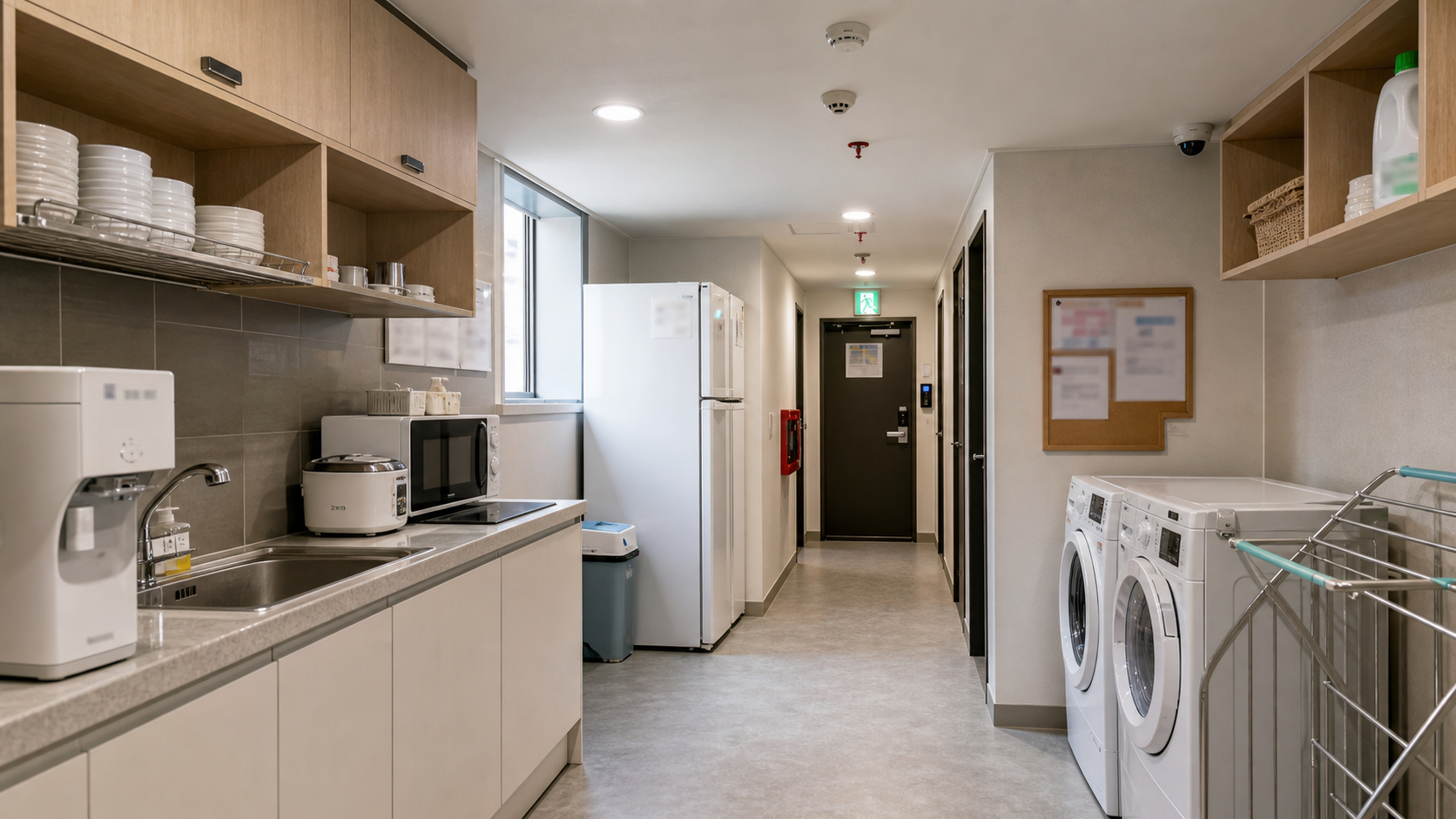
AI-generated by OpenAI image_gen for X30. This fictional composite was selected from the supplied image set; notices are unreadable and no real building or resident is shown. The scene follows the Seoul Metropolitan Government safety criteria and current building standards.
How to Find and Compare a Goshiwon in Seoul
Where to search first
Start with a goshiwon-focused platform, then cross-check the exact building on a map and contact the operator directly. The following routes cover most useful starting points:
| Search route | Best for | How to use it |
|---|---|---|
| Gobang | One-person housing with a dedicated goshiwon and one-room-tel category | Search by neighborhood, subway station, or university, then compare room types and filters. |
| Goshipages | Goshiwon-focused listings | Build an initial shortlist, then confirm vacancy, room number, bathroom type, and total cost with the operator. |
| Naver Pay Real Estate | A wider view of studios and neighborhood prices | Search the Korean neighborhood name and compare nearby alternatives; goshiwon coverage can vary. |
| Dabang or Zigbang | Broader Korean rental-app searches | Use Korean keywords and the in-app call or chat function. Treat photos as a shortlist, not a final inspection. |
| Naver Map or KakaoMap | Direct local searches | Search 고시원 + station or neighborhood, check the entrance and reviews, and save the listed phone number. |
Contact routes matter too. For a specific room, use the phone or chat button on the listing, or call the operator shown on the property page. A platform’s customer-service number can explain the service, but only the property operator can confirm today’s vacancy. Gobang’s official site lists [email protected] and 070-8956-2169 on weekdays from 10:00 to 19:00 for platform support (Gobang); it is not a substitute for confirming a specific room. For multilingual city or foreign-resident guidance, Seoul’s official information lists the Dasan Seoul Call Center at 120 and the Seoul Foreign Resident Center at 02-2229-4900. Language availability and hours can change, so check the current Seoul Foreign Resident Portal guidance before calling.
1. Search with Korean and English terms
Use 고시원, 고시텔, 원룸텔, 리빙텔, goshiwon, and goshitel. Add the neighborhood or station: 신촌 고시원, 대학동 고시텔, or Hongdae goshiwon.
2. Build a shortlist, not a single choice
Compare at least three rooms in the same area. Record the monthly fee, deposit, room size, window type, bathroom type, included utilities, distance from the station, and move-out notice period in one note.
3. Ask the questions that photos cannot answer
Useful Korean questions include:
-
외창 있어요?— Does the room have an exterior window? -
개인 화장실 있어요?— Does it have a private bathroom? -
관리비 포함이에요?— Is the management fee included? -
퇴실 며칠 전에 말해야 해요?— How many days’ notice do I need before leaving? -
거주확인서 발급돼요?— Can you issue a confirmation of residence?
4. Visit before paying
Stand in the room for a few minutes. Open the window, run the tap, test the Wi-Fi if possible, listen with the door closed, and walk the route to the stairs. Look at the shared kitchen and laundry during a normal busy period if you can.
5. Get the terms in writing
Keep a written record of the room number, dates, deposit, monthly payment, included services, refund policy, and notice period. Do not assume that a goshiwon arrangement works exactly like a standard studio lease. Address registration, proof of residence, and immigration or subsidy paperwork can depend on the property and agreement, so confirm your specific needs with the operator or an official foreign-resident support channel before signing.
Is a Goshiwon Right for You?
| A goshiwon may fit if you… | Look for another option if you… |
|---|---|
| Need a furnished base quickly | Need a full kitchen for regular cooking |
| Prefer a small deposit and monthly flexibility | Need generous storage or a separate work area |
| Spend most of the day outside school, work, or filming | Need strong soundproofing and a private bathroom as non-negotiables |
| Want to learn Seoul before choosing a long-term neighborhood | Are planning a long-term stay without checking housing alternatives |
The best goshiwon is not necessarily the newest or most expensive. It is the room whose safety, ventilation, privacy, management, and written terms match the way you actually live.
Build Your Seoul Base with X30
A practical room can give you a starting point while you learn the city, build a local routine, and work on your next piece of content. When you are ready to explore Seoul through creator partnerships, browse the latest X30 campaigns.
References
- Korean Basic Dictionary — 고시원
- Academy of Korean Studies — 고시촌
- Yonhap News — Goshiwon’s history and changing role
- ChosunBiz — 1.5-pyeong goshiwon field report
- KBS News — Goshiwon room-scale report
- Hankook Ilbo — Goshiwon room and private-shower field report
- MBC News — Youth housing and goshiwon report
- The Korea Times — 2026 goshiwon room-tour report
- Seoul National University Newspaper — Recent goshiwon reporting
- News Tomato — 2025 field report on youth alternative housing
- Gobang — Official one-person housing platform
- Gobang — Dream Livingtel Seocho listing
- Goshipages — Goshiwon listings
- Goshipages — One Room Goshiwon in Anam
- Gobang — Wow Village in Sinchon
- Naver Pay Real Estate
- Dabang — Official real estate app
- Zigbang — Official real estate platform
- News1 — “'고시원이라도'” Gwangjin-gu field photo
- Gobang — Monthliv Anam Station listing
- Gobang — Residence Raum near Konkuk/Sejong University
- Ministry of Data and Statistics — 2024 one-person household statistics
- Seoul Metropolitan Government — Youth population and one-person living context
- Korea JoongAng Daily — International students’ goshiwon experiences
- Study in Korea — Living and housing information
- Seoul Foreign Resident Portal — Global Real Estate Agencies
- Seoul Foreign Resident Portal — Essential living and emergency contacts
- Seoul Metropolitan Government — Safe Goshiwon criteria
- Seoul Metropolitan Government — Safe Goshiwon program
- National Law Information Center — Multiple-living facility building standards


